The Attraction – Elizabeth Sonder

The Attraction

Palace Games — San Francisco, CA

A 120-minute fully immersive escape room built from the ground up. Custom electronics, large-scale mechanical systems, and environment design across six distinct rooms.

By Elizabeth Sonder, Lead Engineer & Environment Designer

Spoiler Warning — This page documents the engineering and design of The Attraction in detail, including mechanical reveals, room transformations, and puzzle systems. If you plan to play and want to go in fresh, book your session first.

~120 Min 4–8 Players Live & Booking TERPECA Top Rooms 2021–2024 TERPECA Finalist 2025 Best of Morty 2022 & 2023 Golden Lock Award 2022

The Attraction is a large-scale, fully immersive escape room at Palace Games in San Francisco. Players are transported through a narrative journey across six unique environments using a motorized rotating chamber, interactive sensor-driven puzzles, and rooms with mechanically transforming architecture. I led the engineering and environment design across the full scope of the build, directing a team of mechanical engineers, welders, fabricators, and electricians through electronics, set construction, lighting, mechanics, and atmospheric systems.

Six Rooms. One Continuous Journey.

The Attraction’s narrative casts players as investigators uncovering a mysterious condemned sideshow from San Francisco’s 1915 World’s Fair. Magical immersion is key, and players never see a wire they aren’t meant to see.

The experience moves through six distinct environments: an introductory parlor, The Ship, and three destination rooms (a bioluminescent Forest, a Victorian Library, and a hexagonal puzzle chamber) before returning players to a transformed Cage for the finale.

As lead engineer and environment designer, I directed a multidisciplinary team of mechanical engineers, welders, fabricators, and electricians across the full technical and physical build: interactive puzzle electronics, a three-phase motorized turntable, mechanically transforming room architectures, sensor arrays, atmospheric effects, and all set fabrication and design.

“No one can walk into that experience and not leave with their jaw on the floor.”

— Kyle, Verified Review
VenuePalace Games, San Francisco, CA
Experience TypeFully immersive escape room
Duration~120 minutes
Group Size4–8 players, private
Environments6 distinct rooms
TransportMotorized rotating chamber (The Ship)
Control HardwareArduino Mega, Raspberry Pi
Interactive SurfacesCapacitive touch, IR distance, IR breakbeam sensors
Architectural FXMotorized ceiling (The Cage), hinged panel reveal (The Library)
Visual FXRGB paint layering, addressable LEDs, projection mapping
My RoleLead Engineer & Environment Designer. Directed team of mechanical engineers, welders, fabricators & electricians
StatusLive — palace-games.com
Build Highlight 01

The Ship: A 9-Foot Motorized Rotating Chamber

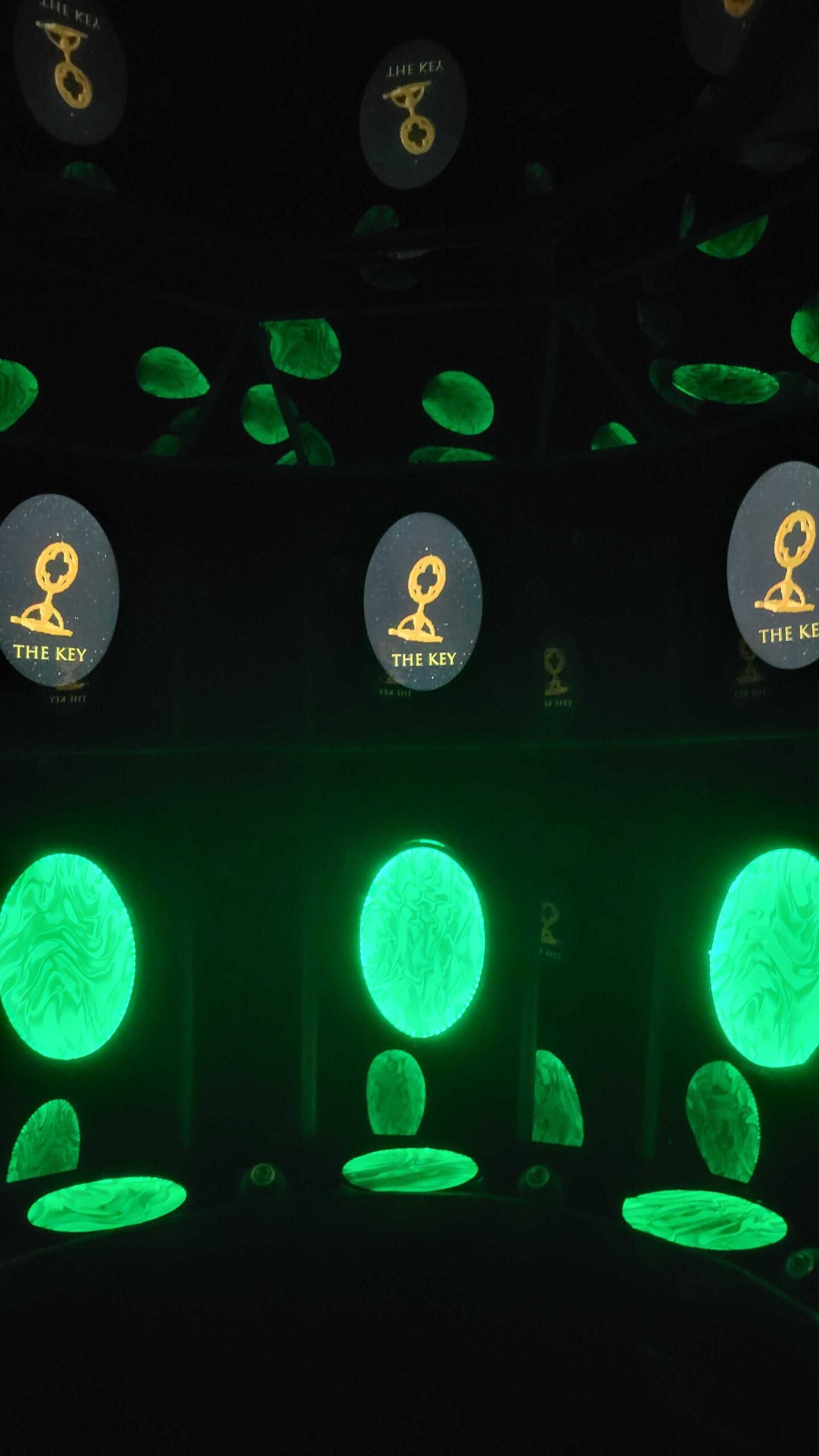
The Ship is the mechanical heart of the experience and its most ambitious engineering challenge. Players board a 9-foot circular room (a black, inky void lined with curved seating, oval LED screens overhead, and embedded trackballs) and are slowly rotated to three different destination rooms before being returned to the start. The rotation is nearly imperceptible as players are bombarded with vibration and sound, creating a fantastic reveal at each new world encountered.

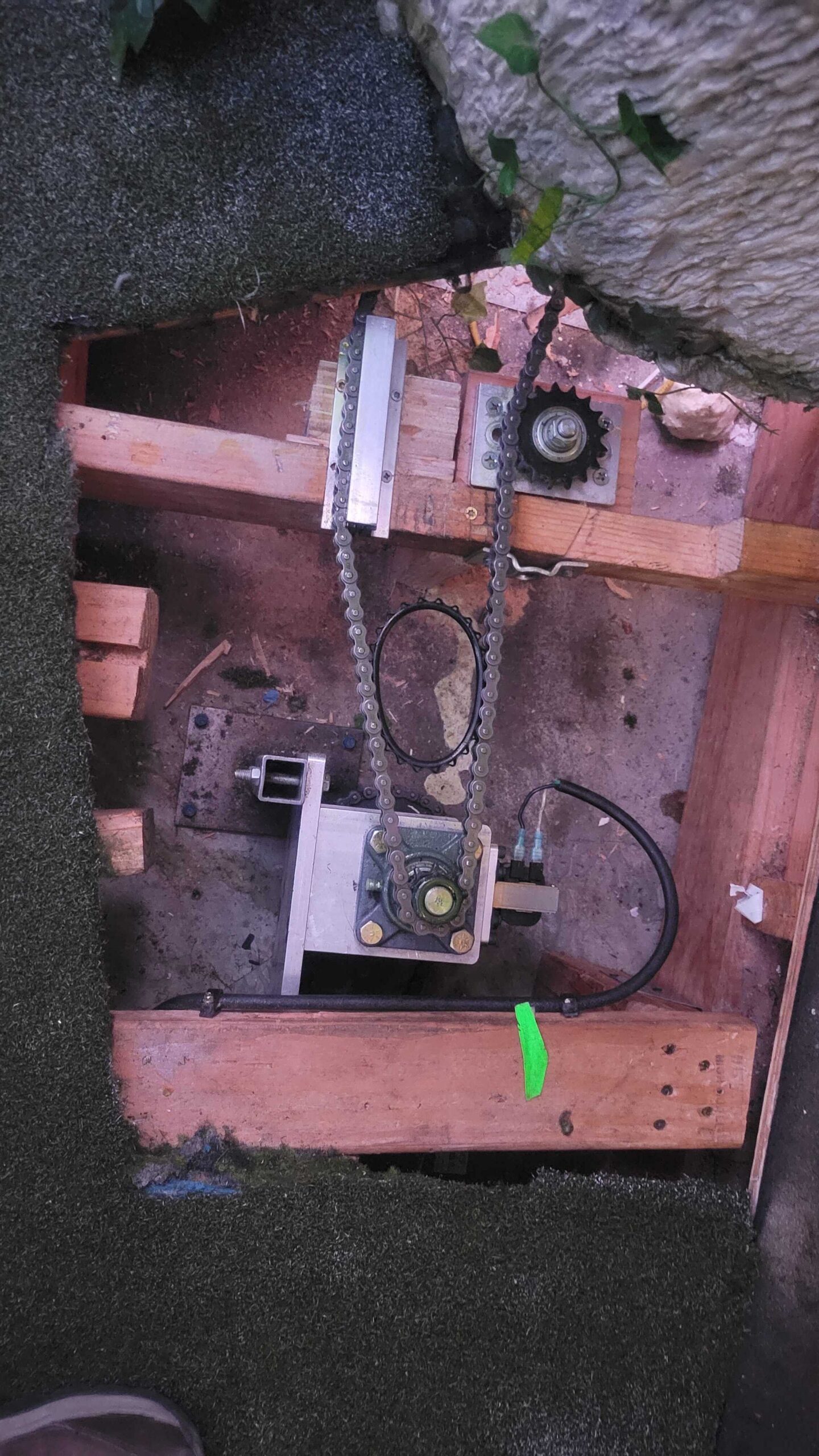
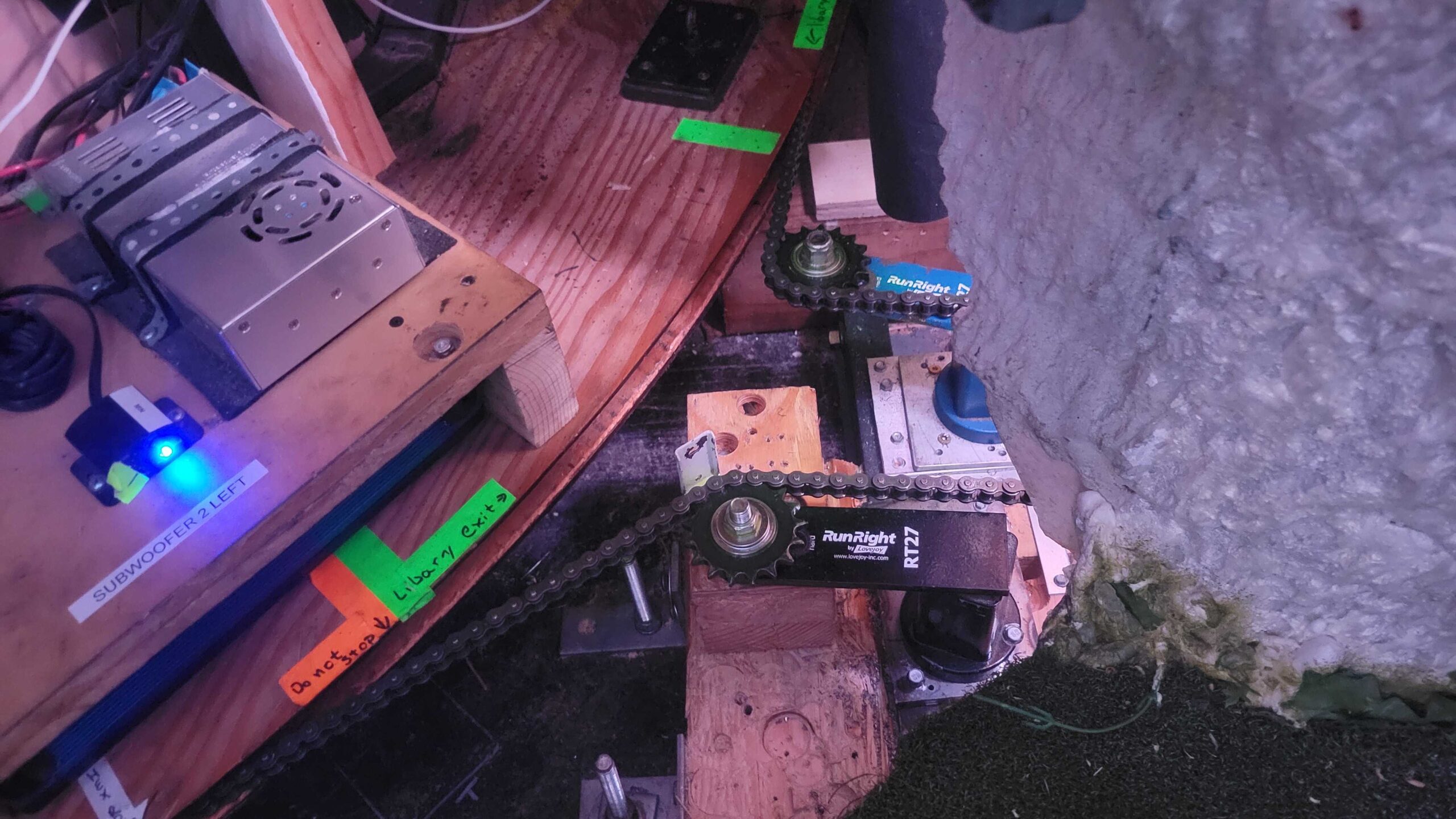
The platform sits on a mechanized turntable driven by a three-phase motor through a chain-and-sprocket drivetrain. A Lovejoy RT27 flexible coupling isolates motor vibration from the platform structure, and a custom chain tensioning system maintains consistent drive engagement around the 9-foot base ring. Subwoofers mounted below the floor deliver animations meant to mask the movement of the ship.

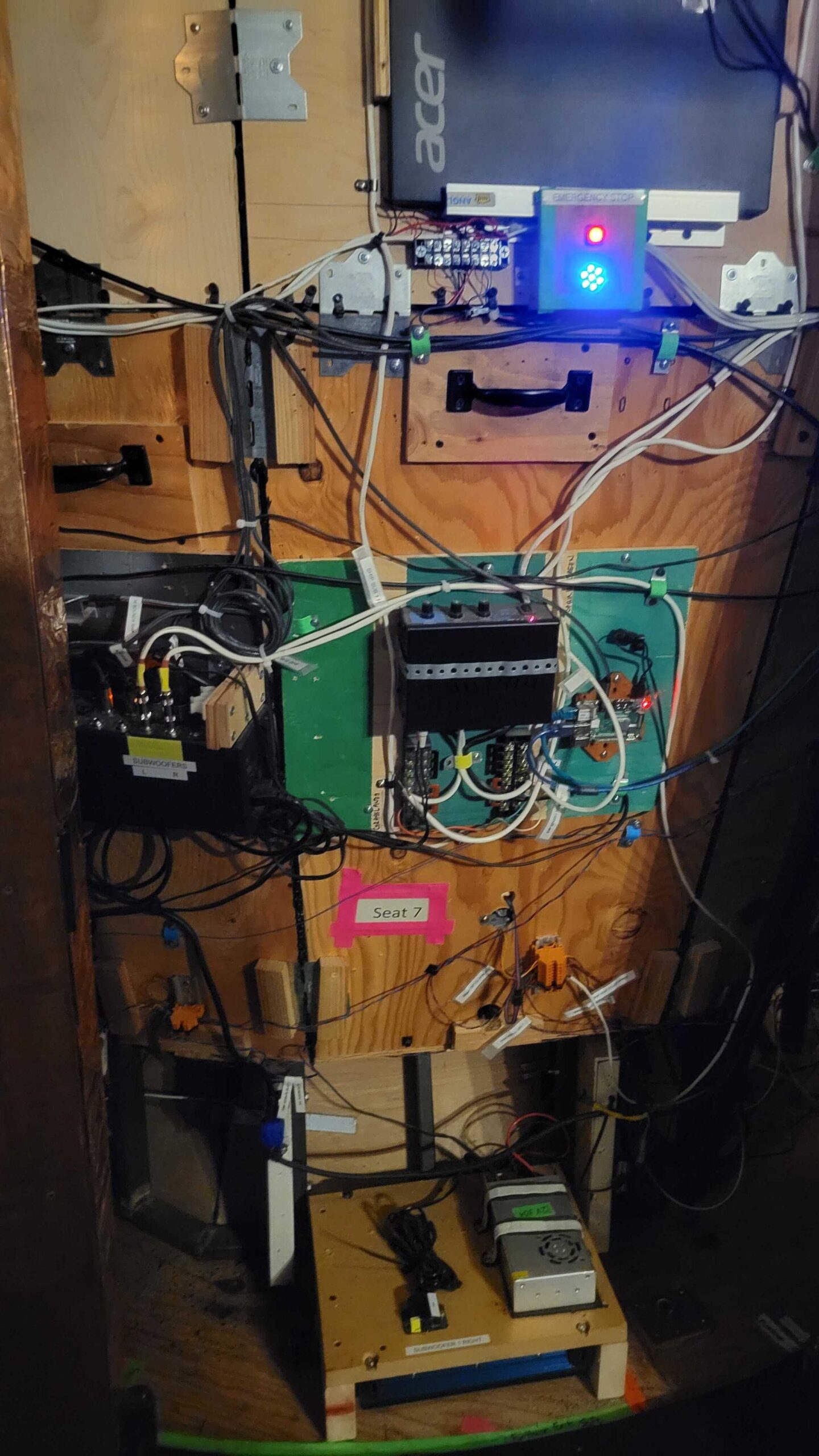
Positioning is handled by a redundant dual-sensor system: inductive sensors around the exterior of the base ring provide coarse positional reference for macro navigation between rooms, while IR sensors around the top of the platform provide fine correction data for precise door alignment. The two sensor types cross-check each other continuously, allowing the control system to make micro-corrections and guarantee that automated doors align perfectly at every stop, every time, through years of use.

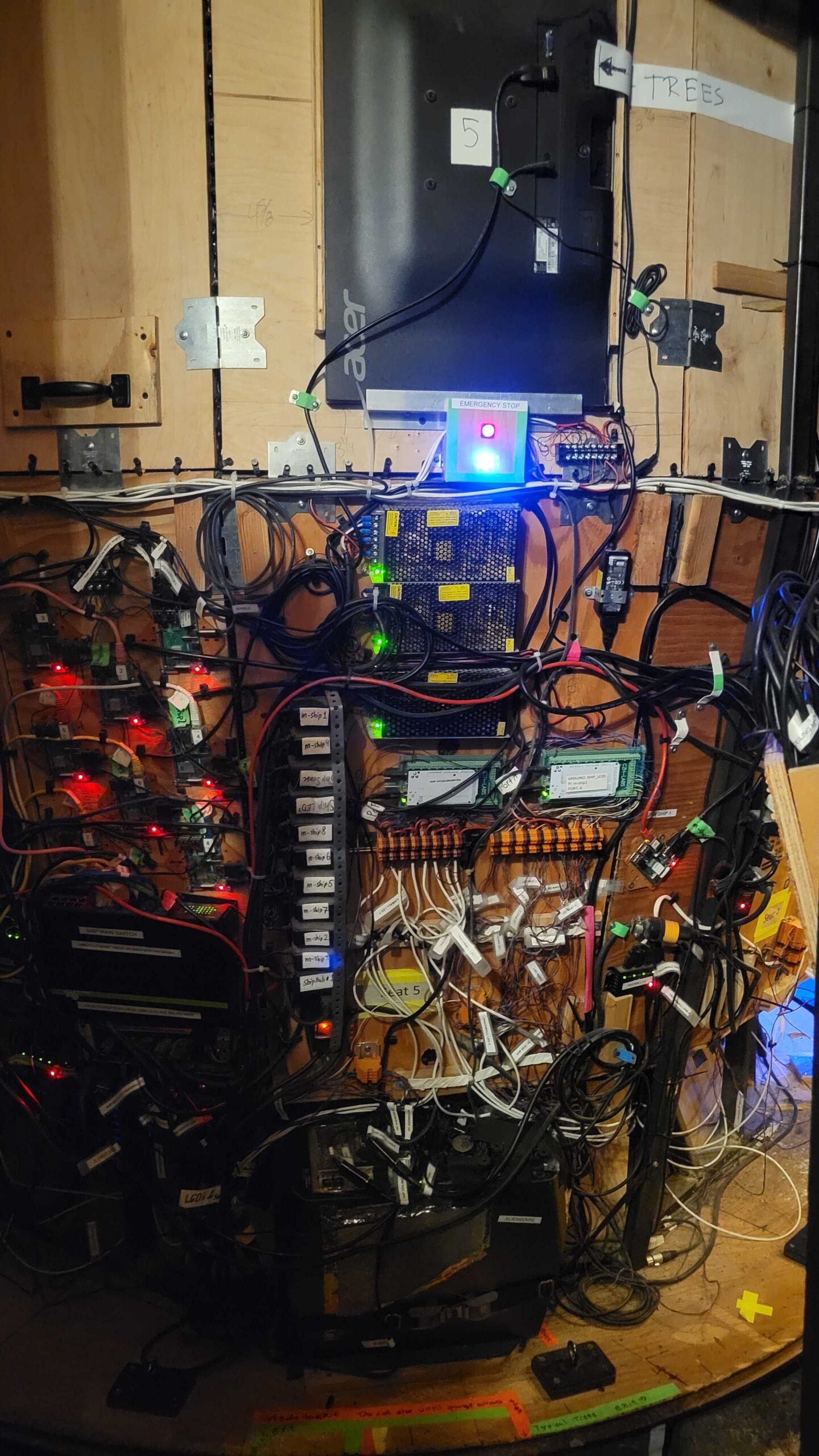
Human presence in the seats is detected via a redundant combination of IR distance sensors and IR heat sensors embedded invisibly beneath the seat surfaces. The control system will not initiate rotation unless all players are seated. Trackballs integrated between the seats give players interactive agency with Unity games on the overhead screens during travel. The Ship is controlled by Arduino Megas and Raspberry Pis coordinating motor control, sensor polling, door actuation, lighting, video, and audio across the full rotation sequence. Alienware controls the Unity games.

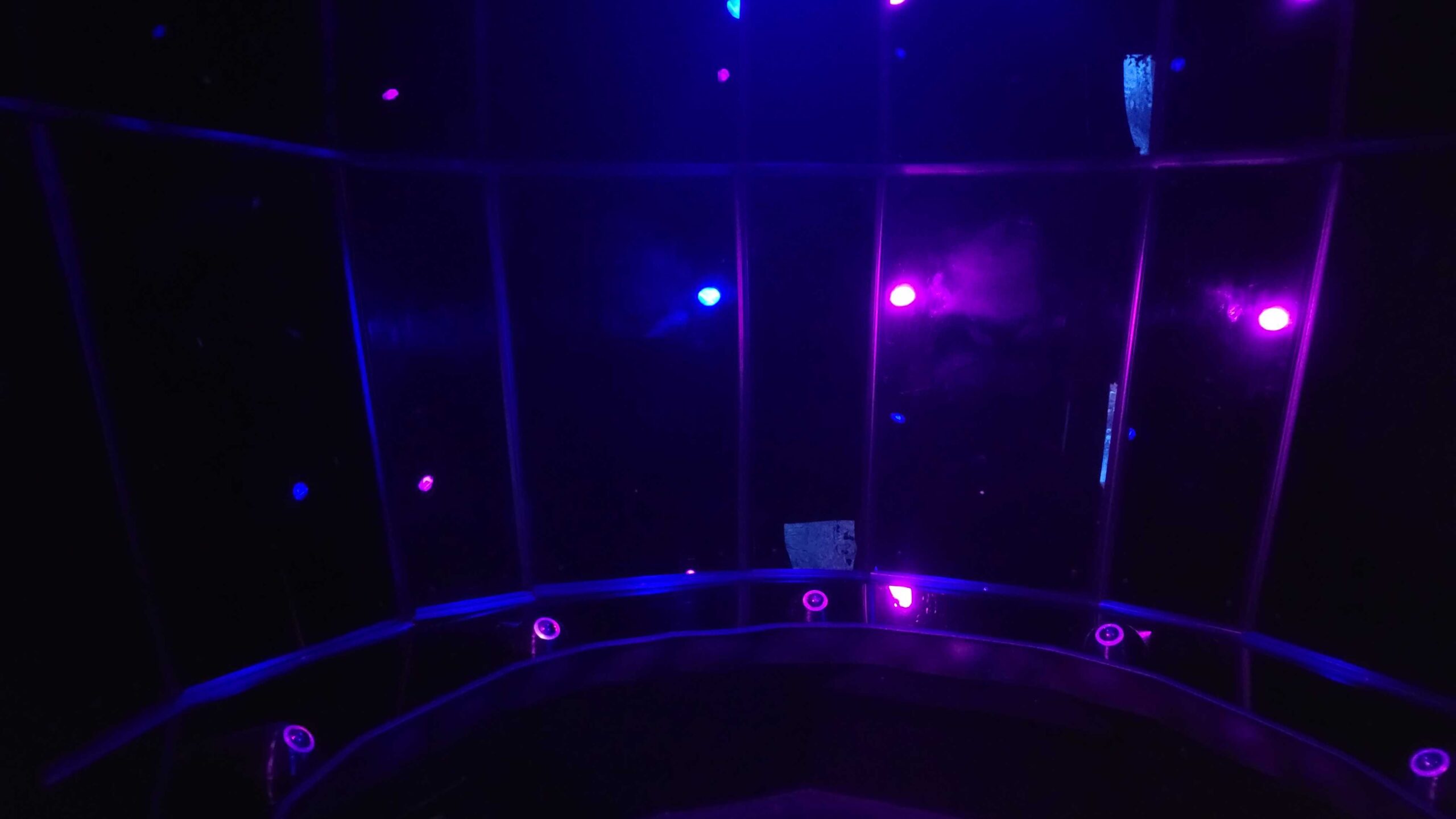
Ship interior, LEDs off

// Interior of The Ship in idle state. Seat LEDs unlit; screens dark.

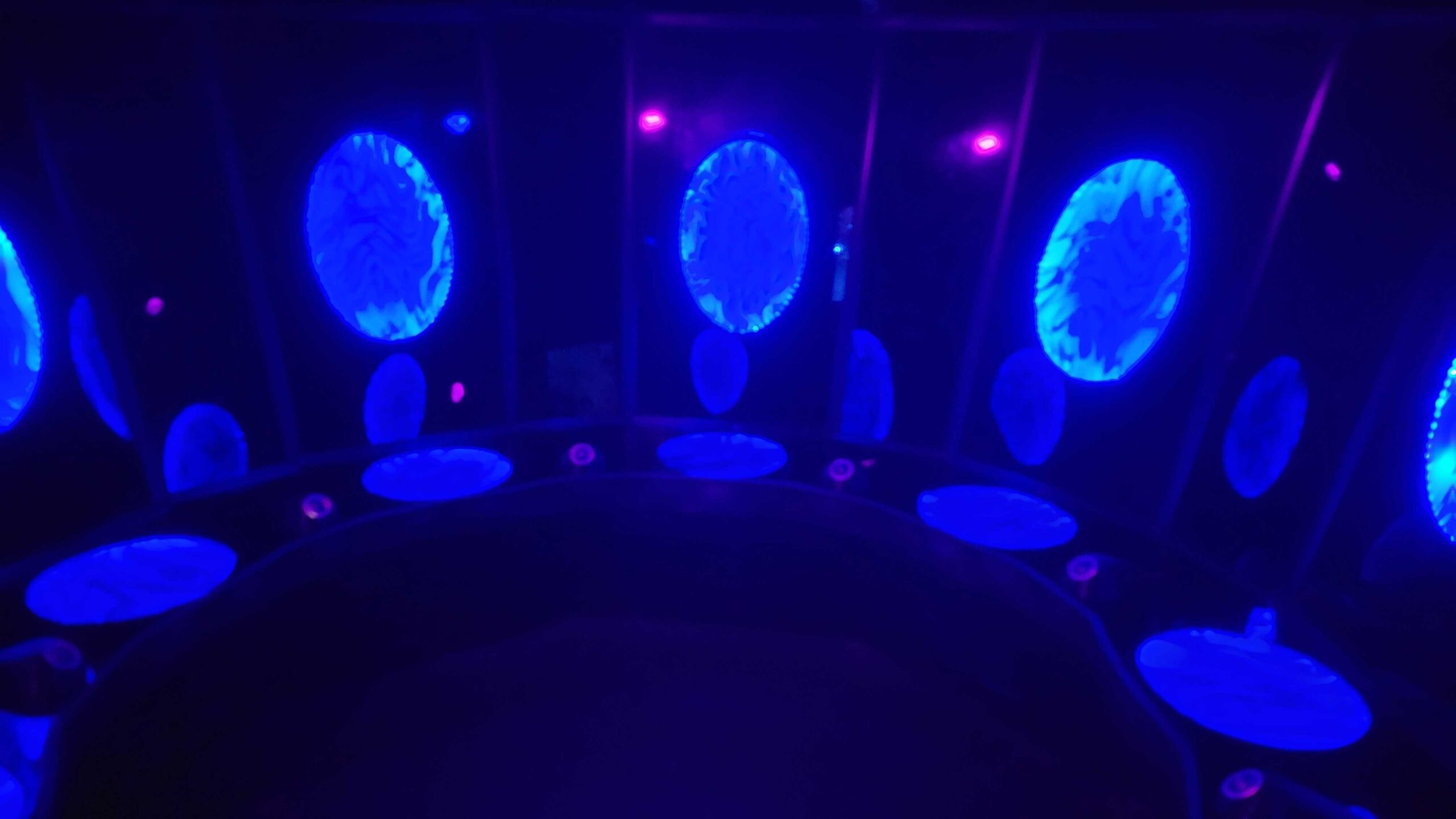
Ship seats, LEDs on blue

// Seat LEDs active. Color palette shifts to indicate seat occupancy states.

Ship seats with overhead screens active, green

// Overhead oval screens active in green.

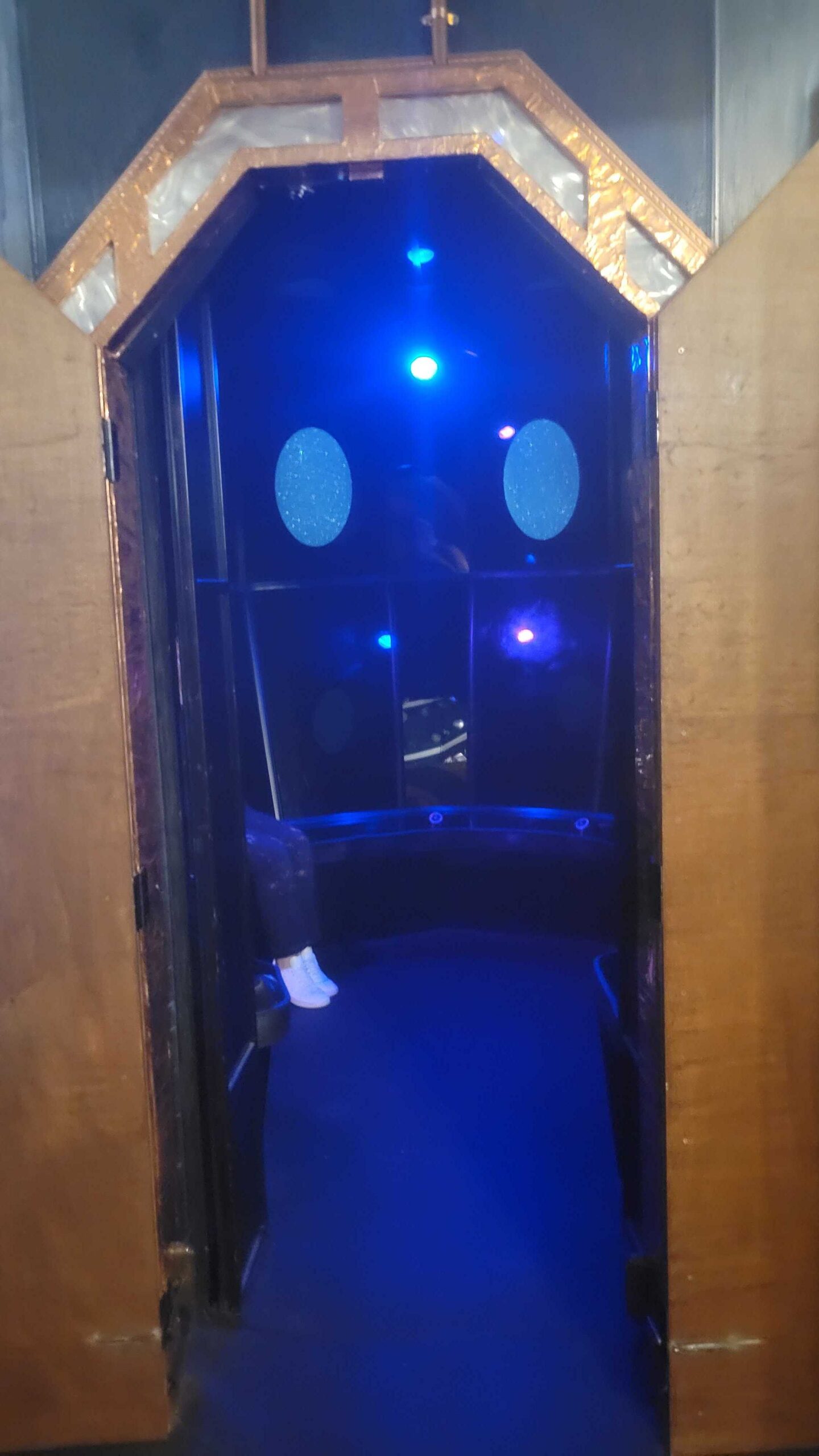
Coffin-shaped entry door into The Ship

// The Ship’s entry door. LED-infused steampunk framing for the void beyond.

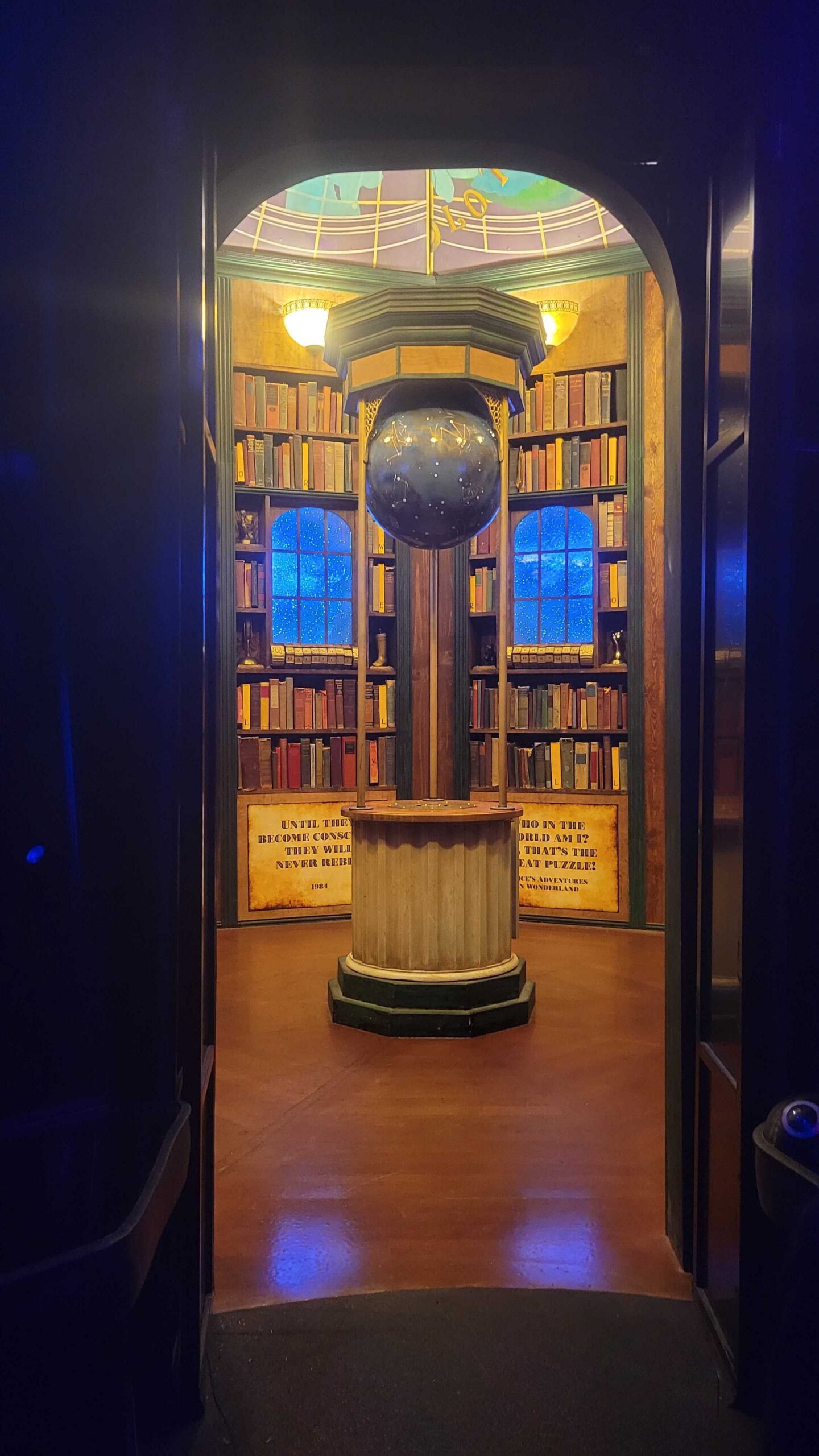
View from Ship into The Library

// The Ship door aligned to The Library entrance.

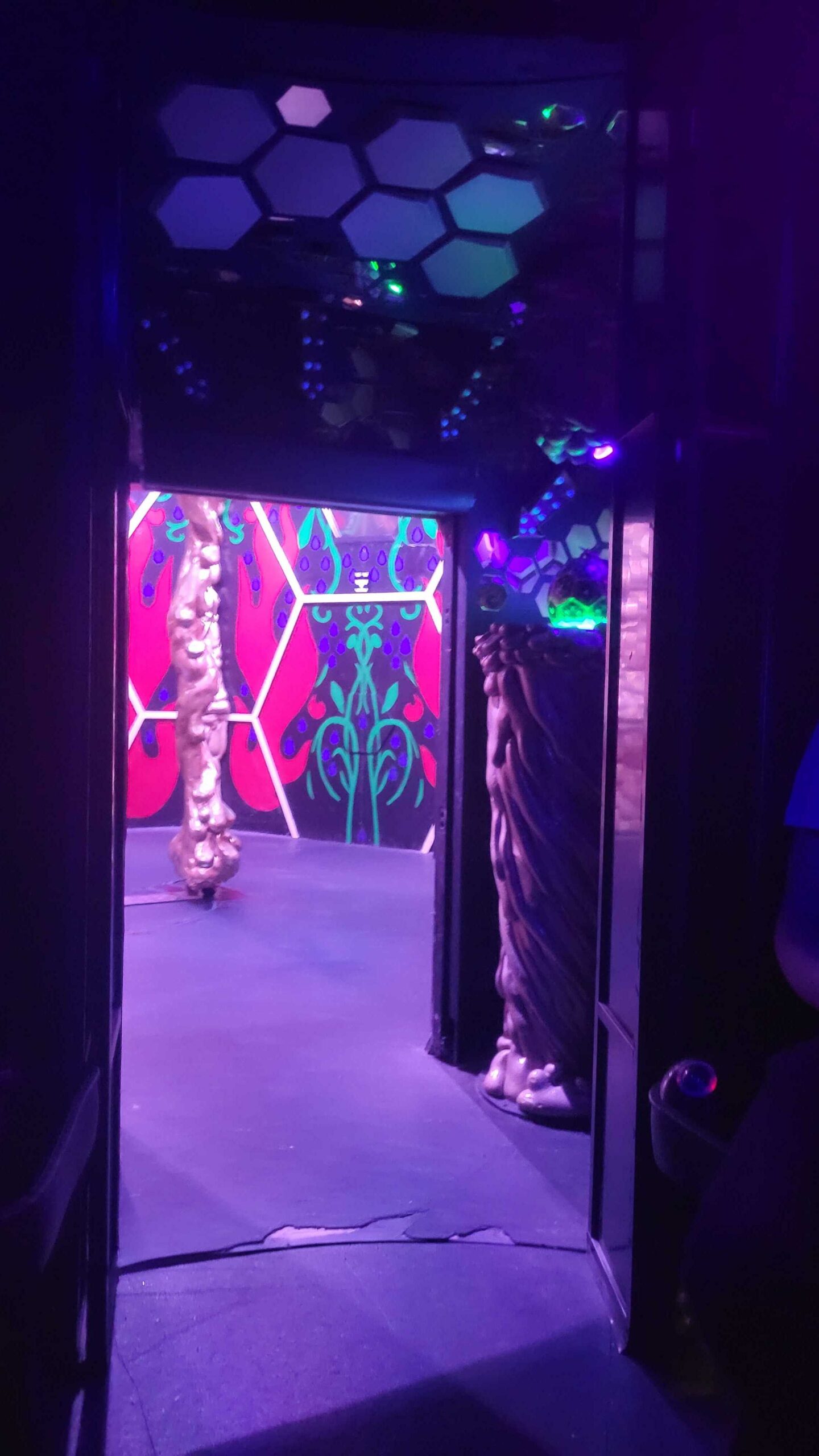
View from Ship into the hexagonal room

// The Ship door aligned to the hexagonal puzzle chamber.

Three-phase motor and chain drivetrain

// Motor, chain, and coupling at sufficient distance from the turntable to isolate noise.

Chain tensioning system on 9ft base ring

// Chain tensioning rig on the base ring perimeter. Tape used during calibration to set stop positions.

Ship external wiring and components 1

// External wiring, sensor mounts, and control hardware on the Ship’s outer ring, never seen by players, but easy to access for maintenance.

Ship external wiring and components 2

// Inductive positioning sensors and IR hardware distributed around the ship’s perimeter.

Build Highlight 02

The Forest: Sensor-Embedded Interactive Trees

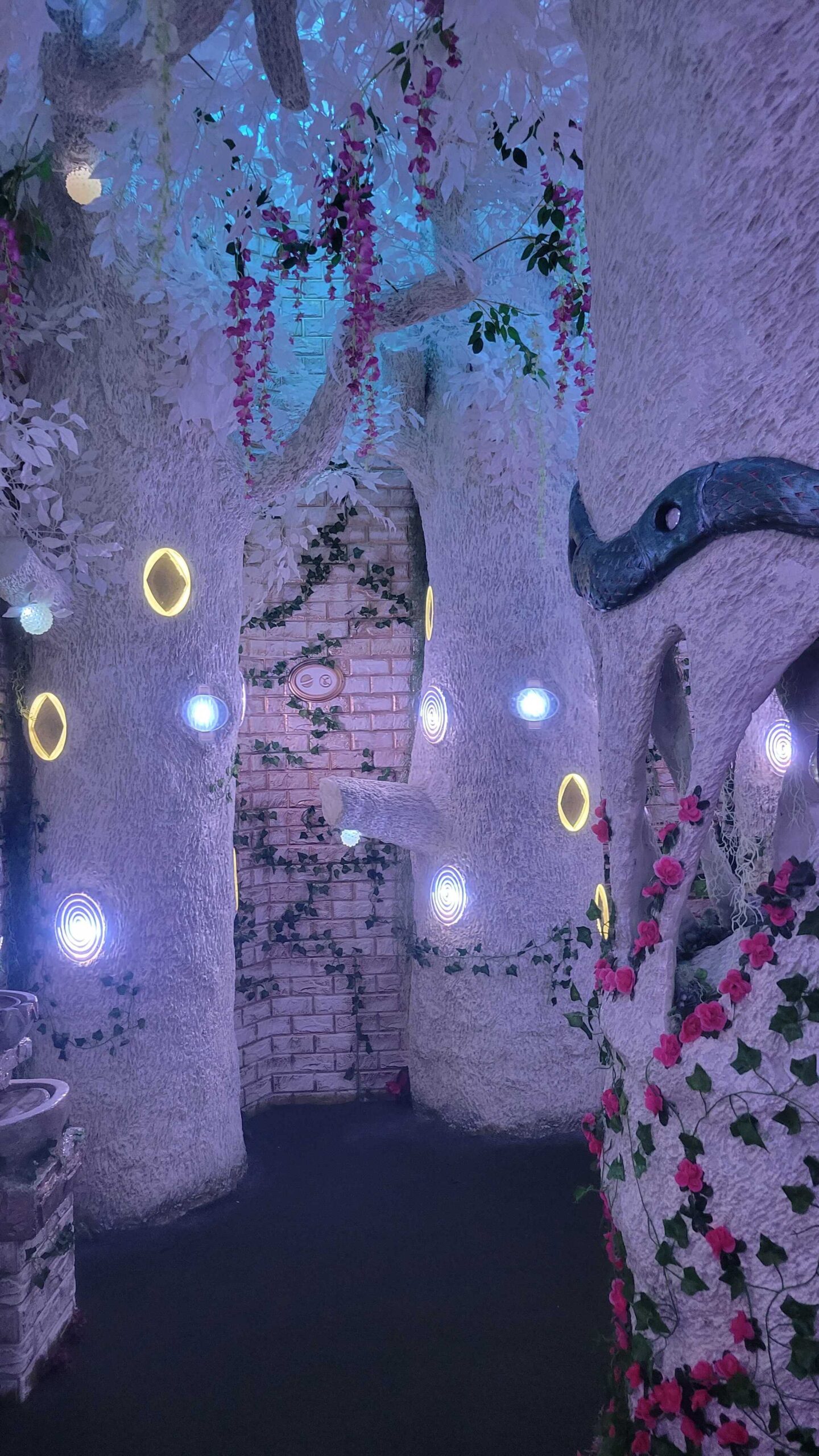
The Forest is one of the three rooms players visit via The Ship. Sculpted trees reach floor to ceiling, draped with wisteria and ivy, their bark embedded with a distributed network of interactive sensors and LED elements, all completely invisible as technology to players moving through the space.

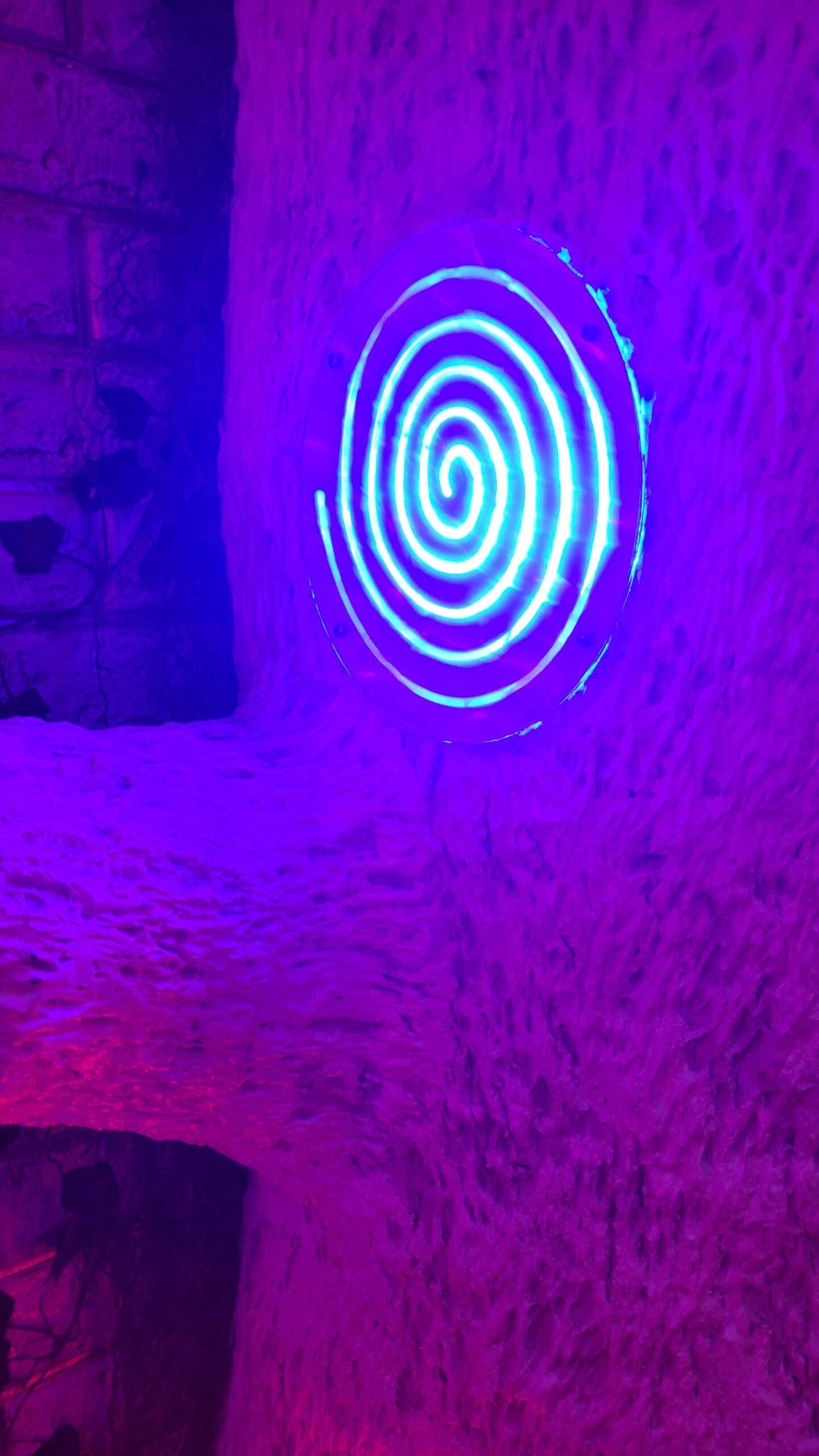
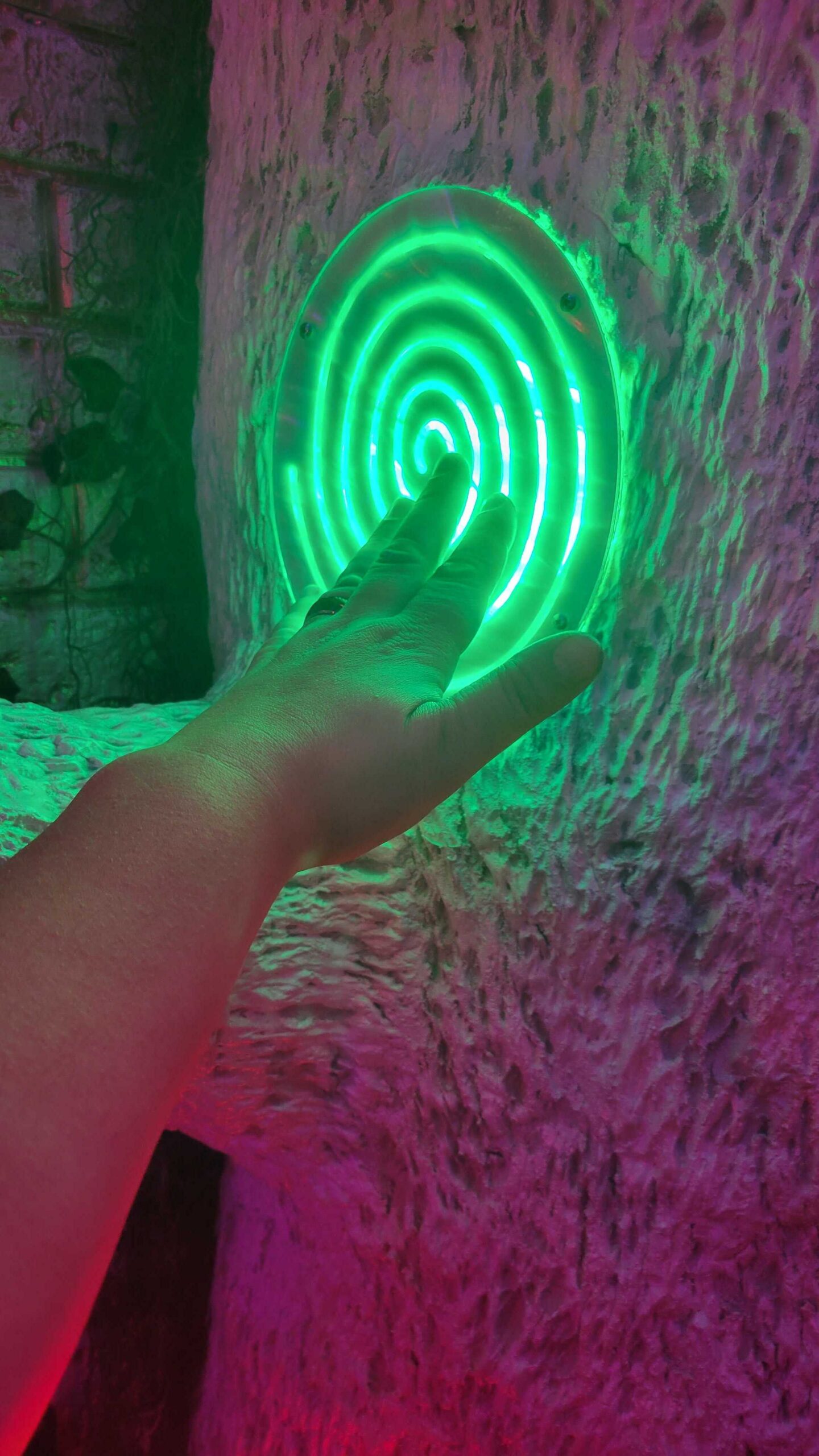
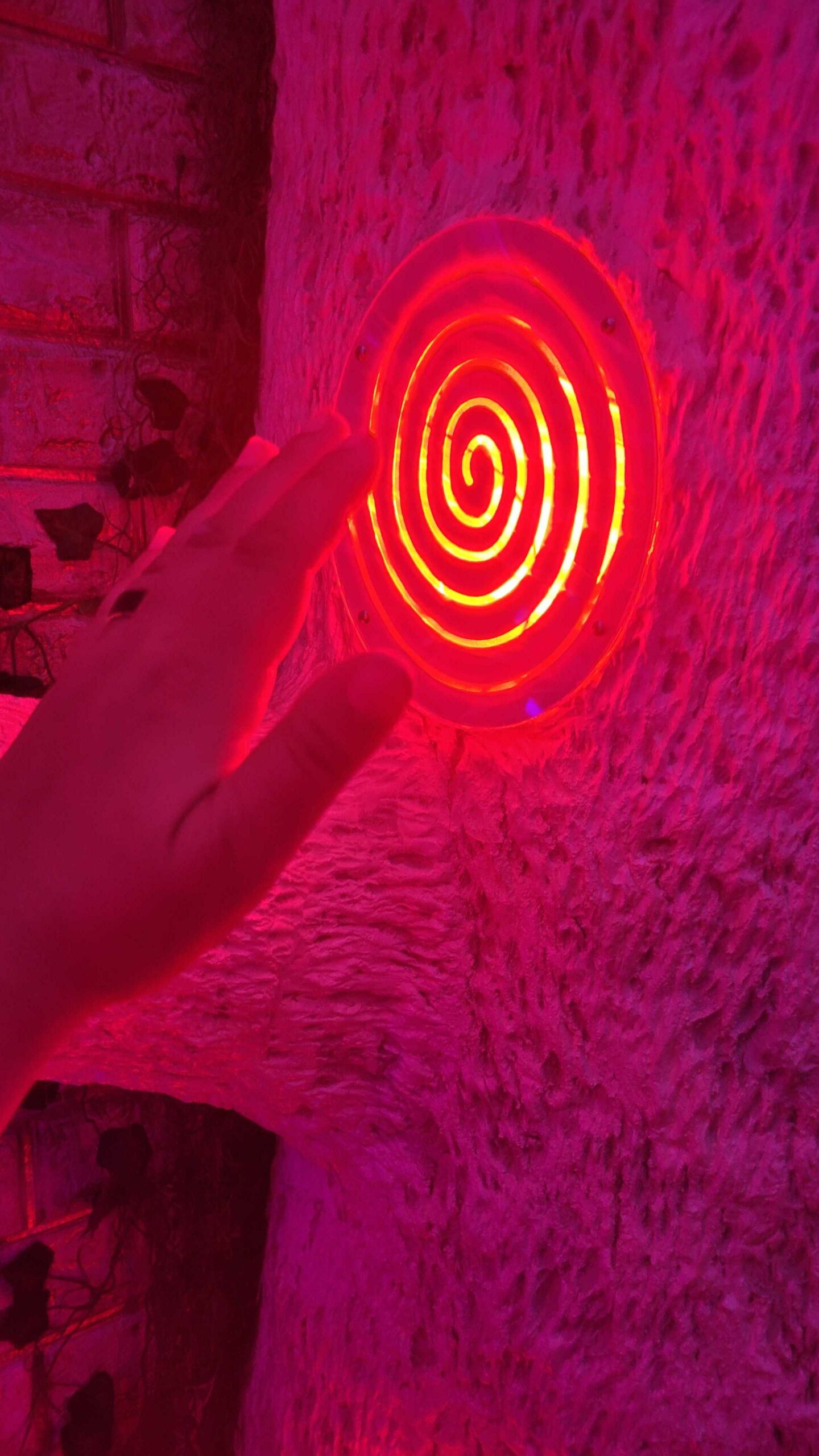
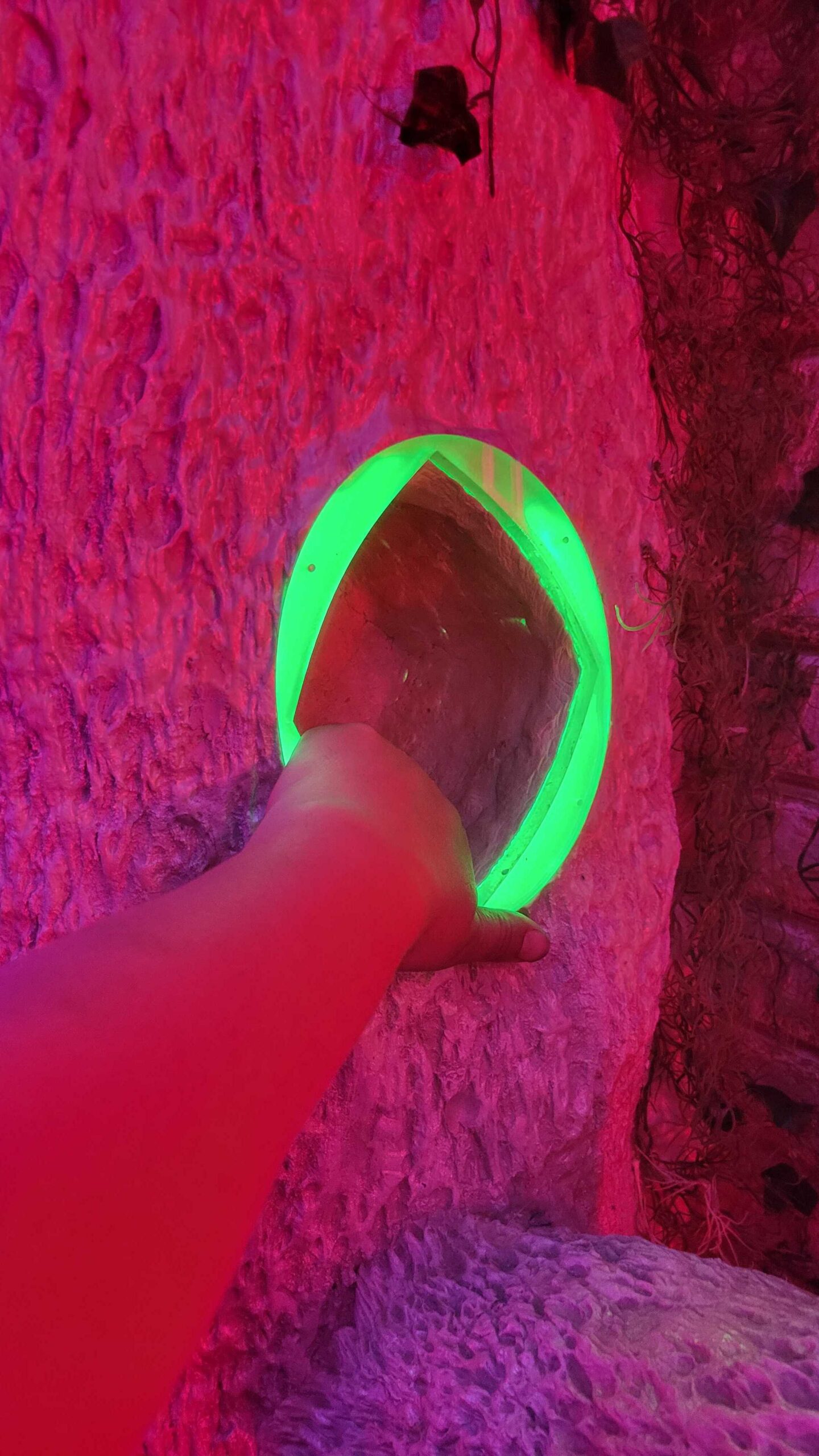
Each tree contains multiple sensor types serving different interaction modes. Spiral-etched acrylic panels flush-mounted into the bark house capacitive touch sensors; touching one triggers an LED animation sequence within the panel itself, with color communicating state (idle blue, active green, confirmed red). Diamond-shaped apertures in the bark are ringed with addressable LEDs that respond to proximity and game state. Oval knots in the tree surfaces contain IR breakbeam sensors, detecting when a hand is inserted, creating puzzle gating that feels like discovering a hidden hollow rather than pressing a button.

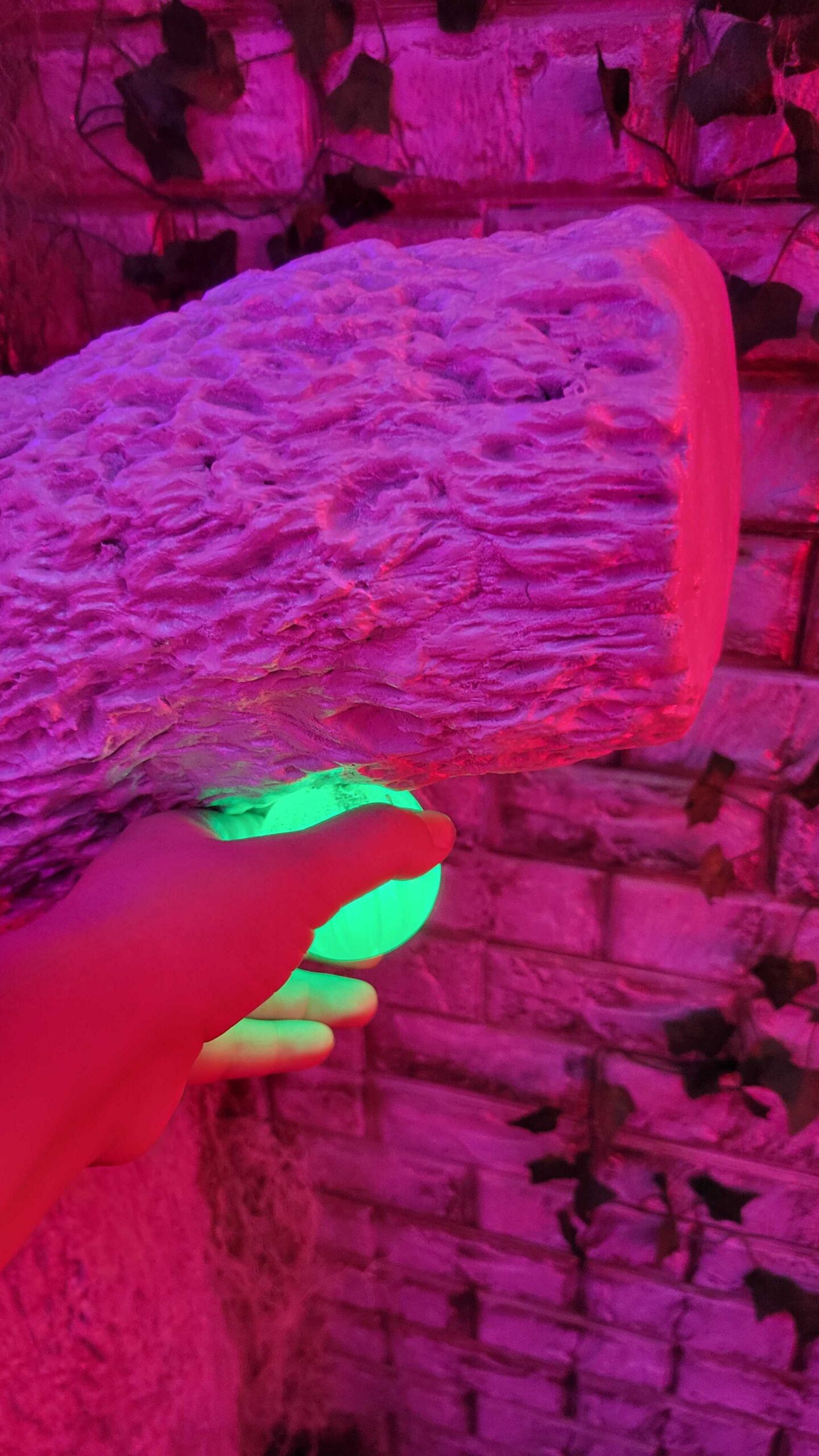
Capacitive touch “fruit” grow from the trees: pullable forms cast in epoxy around addressable LED cores, which glow and animate when touched or pulled. The result is a room where every interactive surface has a diegetic form. Nothing reads as a button, a sensor, or a panel, yet the room is densely instrumented, inviting players to explore and play.

The animatronic giant eyeballs mounted high in the tree canopy react to player presence and game state, completing the impression of an environment that is genuinely watching and responding.

The Forest panoramic

// The Forest. Dozens of LED and sensor elements distributed across tree surfaces, each concealing an interactive element.

Capacitive touch spiral idle blue

// Idle: blue.

Capacitive touch spiral touched green

// Touché: green.

Capacitive touch activated red

// Confirmed: red.

IR breakbeam tree knot with hand

// IR breakbeam sensor in tree knot aperture. Presence-detection for puzzle gating.

Pullable epoxy-cast LED fruit

// Addressable LEDs cast in epoxy resin. Gripping or removing triggers game events.

Build Highlight 03

LED Environmental Animation: Three Rooms in One Set of Walls

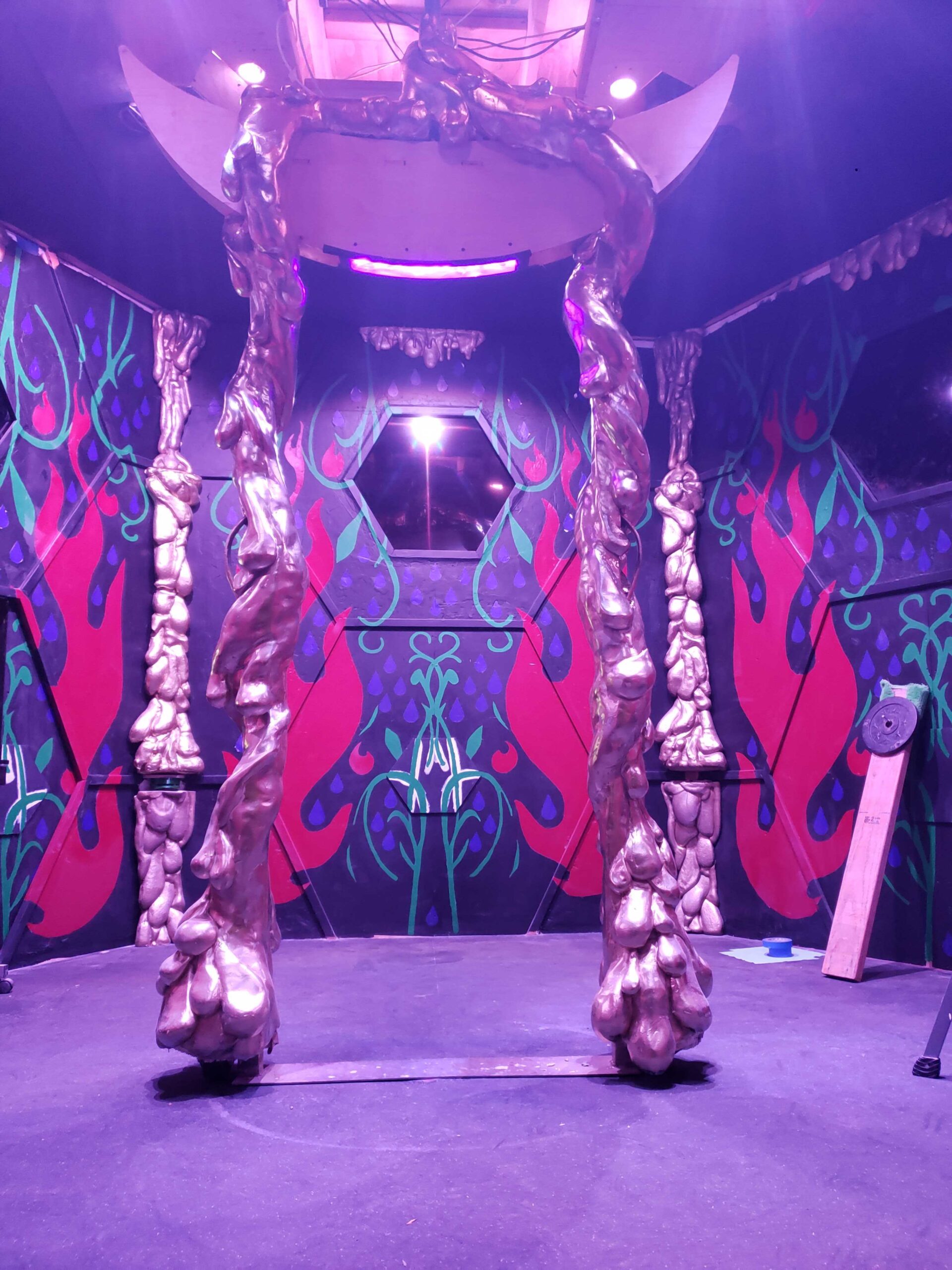
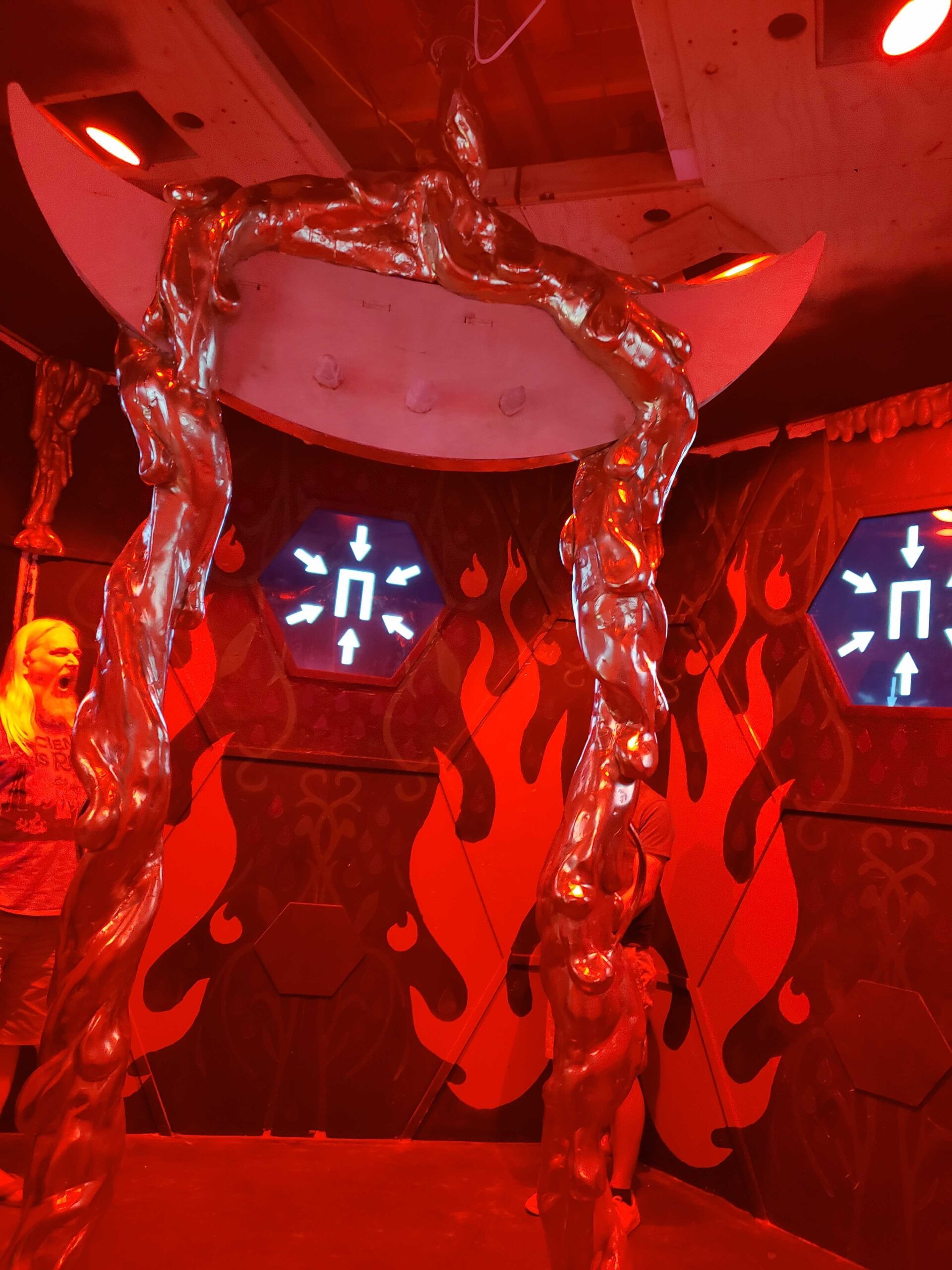
The hexagonal puzzle chamber deploys a technique that multiplies the information density of a single painted environment by a factor of three: the walls are painted in a deliberate tri-color overlapping pattern, with each layer of the design mapped precisely to a single primary color (red, green, or blue).

When the room is flooded with red light, only the red-layer pattern is visible; the green and blue layers disappear into the background. Switch to green, and an entirely different design emerges. Switch to blue, and a third. Players experience what feels like three distinct visual environments within the same physical space.

This is directly integrated with gameplay: players use a rotating “gate” at the center of the room to navigate a honeycomb maze. LIDAR embedded in corner columns allows determination of player position, a mechanism used in kinetic games within. The environmental lighting is driven by addressable RGB fixtures controlled in sync with the game state machine: color transitions are triggered by puzzle events, not manually by a game host.

Hexagonal room neutral state

// The hexagonal chamber in a neutral state, showing the full overlapping tri-color paint design. Each layer dissolves and emerges independently under R, G, or B illumination.

Hexagonal room in red lighting state

// Red lighting floods the room, revealing the red-layer pattern while green and blue designs vanish entirely.

Build Highlight 04

The Library: A 26-Foot Towering Room That Transforms on Puzzle Completion

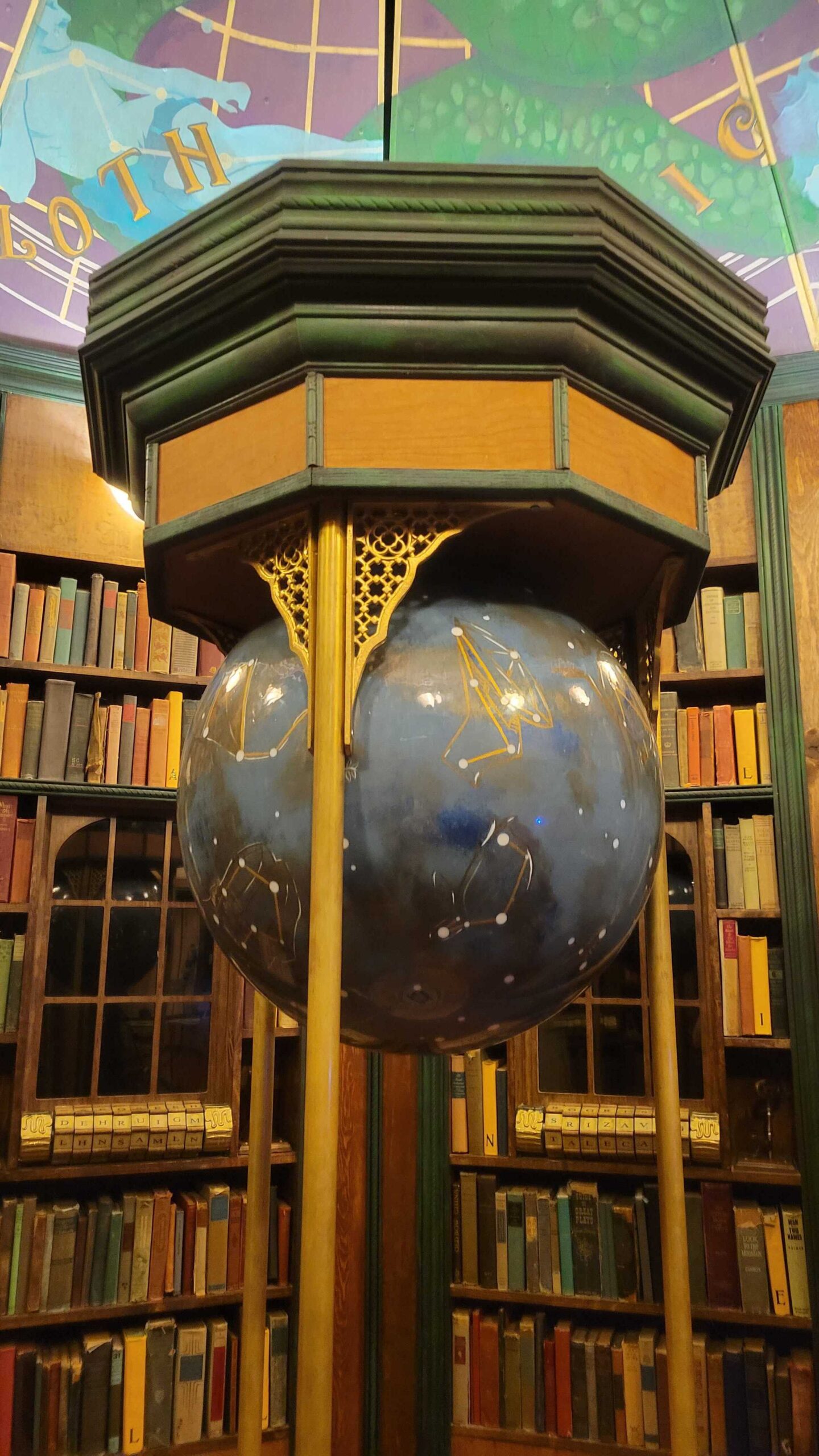
The Library is a Victorian-era circular room rising 26 feet to a projector-screened ceiling. Floor-to-ceiling bookshelves surrounding a central column topped by a hand-painted celestial globe with embedded capacitive touch sensors and LEDs. Screens at the center of each shelf section display puzzle animations and information. The ceiling carries a custom printed constellation map spanning the upper walls.

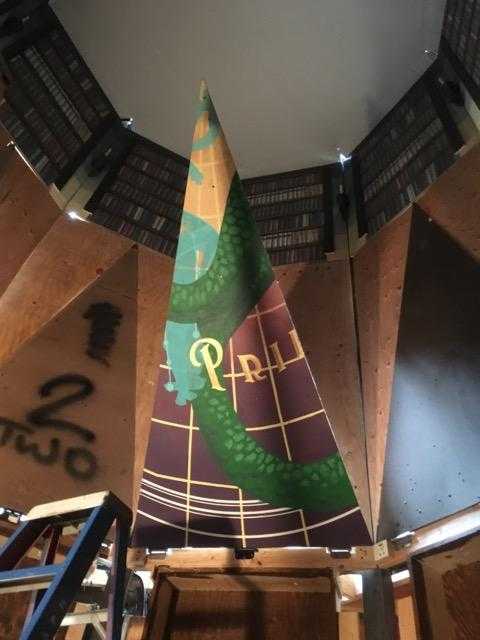
These walls are not what they appear to be. Each of nine rectangular wall panels contains an equilateral triangular segment at its center, hinged at the bottom edge of the panel and held flat by a magnetic lock. The triangular sections are hoisted into their locked position by ropes routed through a pulley system within the steel-framed walls. The hinge lines and mechanical hardware are completely concealed by the decorative molding.

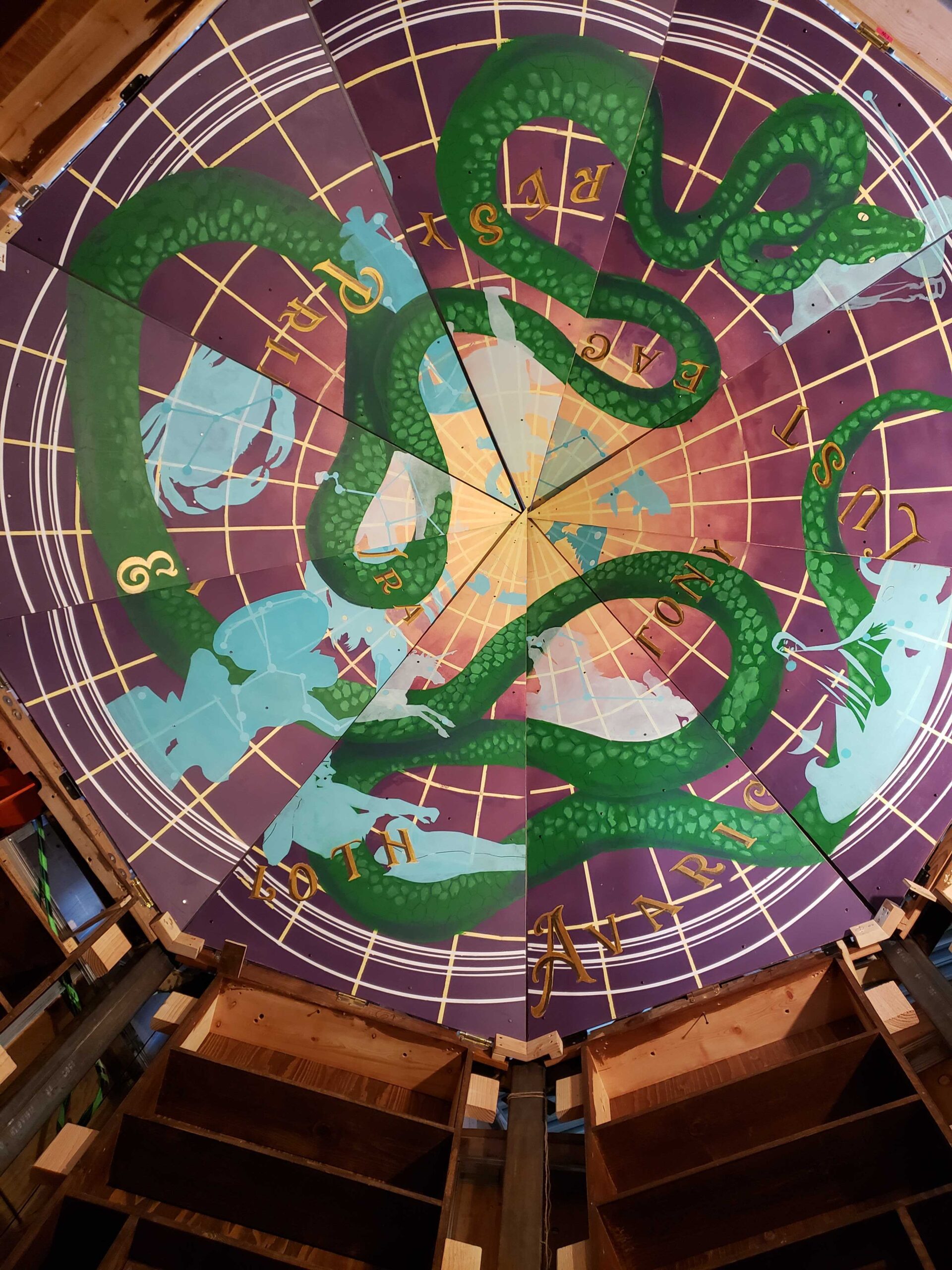
When players solve the Library’s central puzzle, all nine magnetic locks release simultaneously. The triangular panels drop inward on their hinges, rotating downward to converge at a central point, forming a new nine-sided conic ceiling. The newly-aligned triangular sections display a new star map: the solution information players need to proceed, revealed after hiding in plain sight. The transformation takes seconds and is entirely gravity-driven once the locks release.

To reset between sessions, the ropes hoist the panels back to horizontal, the magnetic locks re-engage, and the ceiling is restored. Ropes are routed to a single reset point, requiring a game host to only pull down a single bar to reset all nine panels.

The Library central column and constellation globe

// The Library’s central column and celestial globe. A hidden projector fills the ceiling 26 feet above. Puzzle screens are visible in each bookshelf bay.

Library ceiling panels mid-installation

// During installation. Triangular panel sections and framing visible before decorative finish was applied.

Library ceiling in dropped conic configuration

// The hand-painted star map revealed across all nine panels in the dropped conic configuration.

Build Highlight 05

The Cage: A Room That Transforms Between Sessions in Under 30 Seconds

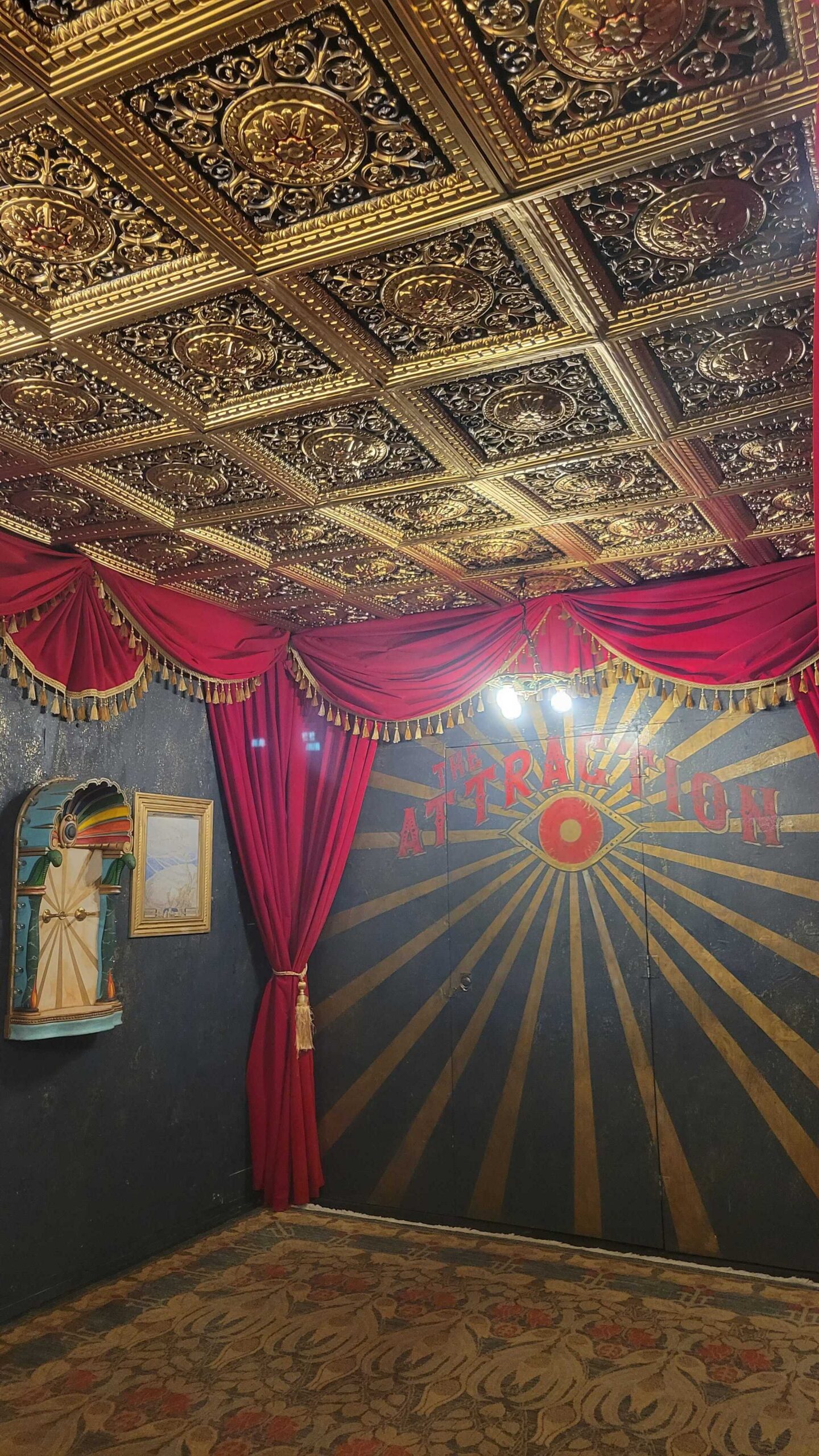
Players begin and end their experience in the same space, but entirely different rooms. What opens the experience as an elegant Victorian parlor, complete with ornate pressed-tin ceiling tiles, red velvet drapes, Persian rugs, and warm candlelight, becomes The Cage: a dark, cavernous trap, with the walls swung closed to seal every exit.

The ceiling transformation is the mechanical centerpiece. A hinged ceiling section is actuated by an electric winch, raising it upward and out of the parlor’s sightline to reveal the cavernous space above. The winch stops automatically in both positions via redundant limit switches, requiring the game host only to flip a single switch. The decorative pressed-tin tiles are continuous across the hinged section, completely concealing the hinge line in both configurations.

Simultaneously, two wall sections swing outward to transform the room seamlessly into an ominous Cage. A hidden door in one wall provides safety egress at all times, invisible from inside The Cage.

The full reset (ceiling lowered, walls swung back open, rug rolled out) is designed to complete in under 30 seconds. The winch handles the ceiling autonomously while the host attends to the walls and rug, making the parallel workflow achievable solo within the window. Players re-emerge into the space in an impossibly short amount of time to the room they first encountered, all traces of The Cage magically vanished.

The Cage parlor configuration with ornate tin ceiling

// The Cage in its parlor configuration (ceiling lowered, walls open). Decorative tin tiles conceal the hinge mechanism completely.

Awards & Rankings

The Attraction has been recognized by the escape room industry’s leading critics and ranking bodies every year since opening.

2025Finalist — TERPECA (Top Escape Rooms Planet Earth Competitive Awards)
2024#80 Top Rooms — TERPECA
2023Best of Morty — Morty
2023#58 Top Rooms — TERPECA
2022Best of Morty — Morty
2022#49 Top Rooms — TERPECA
2022Real-Life — Golden Lock Awards
2021#37 Top Rooms — TERPECA

Critical Reception

Room Escape Artist
2022 Golden Lock Award Winner
“The Attraction thoroughly blew my mind, distorted my sense of reality, and set a new and invigoratingly high bar for the future of escape rooms as an experiential art form.”

“Impressive feats of engineering and Meow Wolf-level immersive artistry converged into something utterly magical.”

“As far as I’m concerned, The Attraction is in strong contention for the best escape room in the world.”

Read the full review →

The Experience, Live

The Attraction has been running live at Palace Games since opening, hosting thousands of players. It is consistently rated among San Francisco’s top escape room experiences.

~120 Minutes

One of the longest escape room experiences in the city. A full narrative arc across six rooms with no filler.

Commercial Scale

Multiple sessions daily. Every mechanical and electronic system was designed for reliability at operational volume, not just demonstration.

Critically Recognized

TERPECA Top Rooms every year since opening (peaking at #37), Best of Morty 2022 & 2023, and a Golden Lock Award, among the most competitive rankings in the escape room industry.